
Researched and written by Evan Swanson, Highline Big Picture Highschool Intern
March 2026
“The world was full of magic out there at Alki and Luna Park, as far as I was concerned.”
– Blanche Caffieire, Southwest Seattle Historical Society oral history interview, October 5, 1999
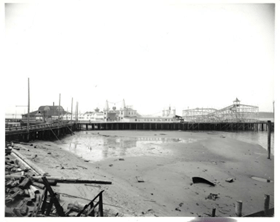
Luna Park was an amusement park built at Duwamish Head in the early 20th Century. It was revered as Seattle’s own Coney Island. Though the park was met with staggering success, just a few years after it had turned its lights on, it was forced to turn them off forever.
Beginnings
Park Engineer Charles I.D. Looff brought Luna Park to life. Looff was born in Germany in 1852 and immigrated to the U.S in 1870, arriving in New York. Looff had exceptional artistic talent as well as fierce ambition. Within a decade of being in the U.S, Charles had earned a reputation as a master carousel carver and had created Coney Island’s first carousel in 1875. In 1906, Looff worked on a carousel for an amusement park in San Francisco, but because of a catastrophic earthquake the same year, those plans were derailed. Looking for a new endeavor, Looff signed a contract with the Seatle Park Company who had just started working on a new amusement park and needed a manager for the new park’s amusements. Looff and a man named William invested $250,000 into the project.
Luna Park construction began in the winter of 1906. The park opened on June 27, 1907. Looff managed the park’s various rides, sideshows, and games of chance. Meanwhile the Seattle Park Company managed the natatorium, dance hall, and cafe.
Luna Park was a place of magic; unlike anything the west coast had seen before. Thousands arrived on opening day having watched the park being built for months. What they found was a place of mechanical wonder, filled with rides and games. Crowds stayed late into the night.
Luna Park Attractions
Amongst the park’s attractions, Coney Island, a carousel constructed by Looff and based off the name of the east coast resort where Looff’s first carousel was made, was the most popular ride at the park. Visitors were able to get a free ride by grabbing a ring out of the holder. In an interview with the Southwest Seattle Historical Society, West Seattle resident George Shepard, recalled “What we use to do was sit on the outside seat and as you went pass the little arm sticking out, you could grab a little metal ring out of a holder. Pretty soon if you got a brass ring or gold ring, that entitled you to a free ride. We use to go on that merry-go-round a lot.”
Other popular rides included the Great Figure Eight Roller Coaster, built by Looff’s son, Arthur Looff, and the Shoot-the-Chutes where passengers would have a brief view of Elliot Bay before barreling down a 200-foot track. To keep public interest, Luna Park also exhibited advanced technologies, including the Electrical Theatre, which was an early form of a movie theater where silent films were shown while musicians played the score.
Luna Park Natatorium
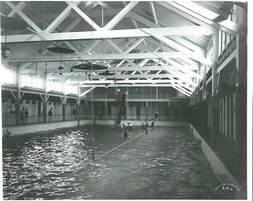
Luna Park was home to one of the few natatoriums in Seattle at the time. It housed three pools (two saltwater and one freshwater) and had room for 1,000 bathers. Compared to Alki Beach, which was a well-known place for bathing, the Luna Park natatorium had a more controlled environment where swimmers could receive instruction, rent swimsuits, and store their belongings in a locker.
Luna Park Entertainment
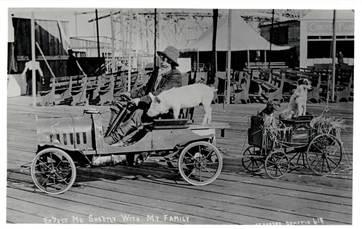
Looff would hire new acts almost weekly. One recuring performer was Carl Hinckley who went by the stage name Uncle Hiram, taken from the song “Hiram Green, Goodbye”. Hinckley would parade around the park with his sidekick Betsy the Pig along with other animals who were harnessed to and pulled his iconic Studebaker wagon. Hinckley left for the Western Washington Fair, briefly leaving Betsy behind before he purchased her from Looff at a later date.
Beginnings of the End
Even with its popularity, the park had its share of controversy. Luna Park was known to have “the longest bar on the bay.” When the Seattle Park Company approached city council with plans for Luna Park, they believed that it was necessary for the park to have a bar to be profitable. For some, the bar proved to be problematic – locals were upset that their city council would allow their community to be overrun by “boozers from Seattle”. As a result, Luna Park was targeted by prohibitionists who campaigned to close down the bar.
Rumors began to circulate. On January 31, 1911, a Seattle Post Intelligencer newspaper article was published claiming that young girls were hanging around the bar, mingling with older patrons, drinking, smoking, and singing. Additionally, the manager of Luna Park, W.W. Powers, was caught up in a scandal involving then mayor, Hiram C. Gill, and the chief of police, Charles Wappenstein. Gill had allowed Wappenstein to build a 500-room brothel on Beacon Hill with Powers as a shareholder.
In the end, despite its initial success, controversy caused Luna Park to lose its magic. While the park was very popular after it opened, its novelty began to wear off. Alki Beach Park, formally established in 1910, continued to soar in popularity. Legal challenges also played a role. Contract disputes between Charles I.D. Looff over the Seattle Park Company operating slot machines at Luna Park ultimately led to court. There were also threats of lawsuits from park visitors, such as a blacksmith who had injured his knee due to a faulty park game. Eventually, Looff cut his losses and sold the park, leaving Seattle three years before the end of his contract. Looff moved to California, where he continued to make and sell carousels. At the end of his life Charles had been a self-made millionaire. Looff passed away at the age of 66.
Luna Park closed in 1913.
Luna Park Legacy
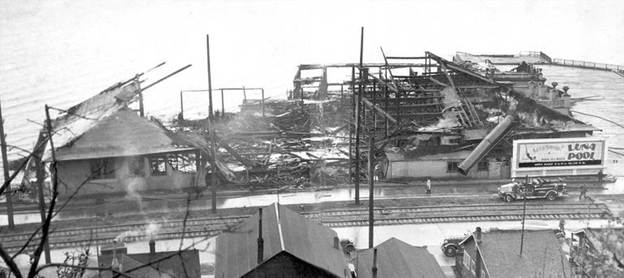
After the closure, the natatorium and dance hall remained open until April 14, 1931, when both buildings were burned down. Carroll Mage, who was working at the natatorium at the time, recalled the fire in an interview with the Southwest Seattle Historical Society. Mage witnessed the fire while on the roof of the Federal Building on 1st and Marion.
“I looked across the water and I saw a light in the sky … a flame. I saw big flames shoot up in the sky and I said, ‘Oh my gosh, Luna Park is on fire!’ I knew where it was by its location. It was the building that housed the dressing rooms and the diving boards that was on fire. This great big wooden framed building, three stories high, was on fire. ‘Oh my gosh, Luna Park is on fire.’” – Carroll Mage
The cause of the fire was never solved, but it was to be believed to be the work of an arsonist. The only part of Luna Park that remains to this day are the pilings that once supported the park, which can be seen when the tides of Elliot Bay are at their lowest levels.
View more photos of Luna Park here.
Sources
- Caffiere, Blanche. Oral history interview, October 5, 1999. Southwest Seattle Historical Society, 2008.24.10
- Burrows, Alyssa. “West Seattle Memories Part 4: Luna Park,” posted August 15, 2001 at https://www.historylink.org/File/3496
- DeMay, Daniel. “A look back at Seattle’s Luna Park, ‘Coney Island of the West,’” Updated Daniel December 12, 2017, at https://www.seattlepi.com/local/seattle-history/article/103-years-on-look-back-at-Seattle-s-Luna-Park-9207993.php
- Dorpat, Paul. “Seattle Now & Then: Luna Park Entrance” posted September 10, 2011, at https://pauldorpat.com/2011/09/10/seattle-now-then-luna-park-entrance/
- Naff. Aaron J.2011. Images of America: Seattle’s Luna Park. Arcadia Publishing.
- Shepard, George. Oral history interview, October, 27, 1998, Southwest Seattle Historical Society, 2008.24.4 Stein, Allen J. “Luna Park-the Coney Island of the West,” posted June 16, 1999, at https://www.historylink.org/File/1390