

Out of Many, One is an initiative from Washington State America250 bringing museums and communities together to identify and exhibit an object from local collections that reflects as aspect of the American experience. This summer, museums across the state will exhibit an object that connects to this theme – “Out of Many, One.” Participating museums will be listed on an interactive online map through the summer.
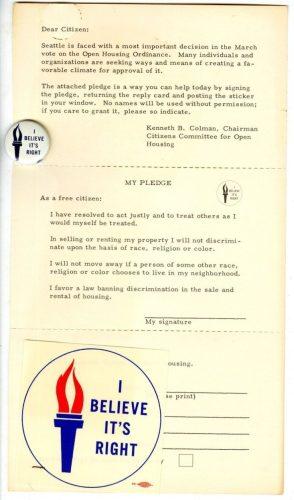
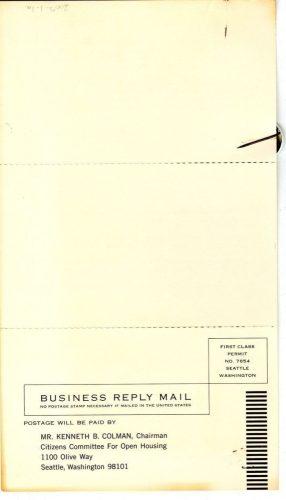
This pledge card, sticker, and pin set comes from the personal collection of the founder of the Southwest Seattle Historical Society, Elliott Couden. It was produced during the Civil Rights Movement in the 1960s, when the Citizens Committee for Open Housing was campaigning to outlaw housing discrimination in Seattle.
Couden, who was a real estate agent based in White Center, supported the Open Housing Ordinance that inspired this pledge card. In 1964, Seattle voted nearly two to one to keep racial housing discrimination legal. Although the referendum failed, a similar effort was pushed through by City Council four years later.
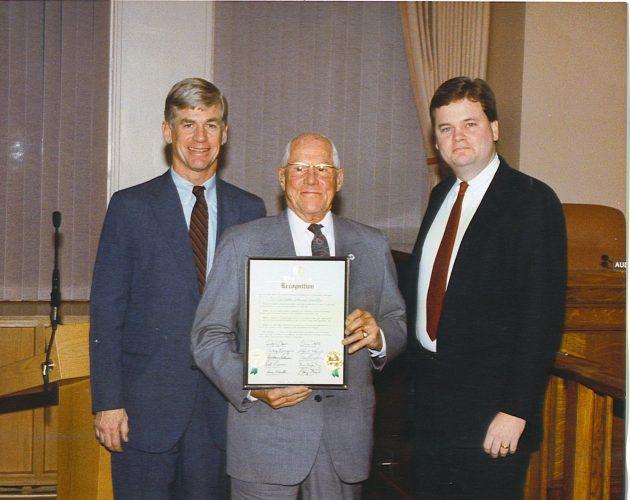
Couden remained active in many causes to advance equity and freedom for all Seattle citizens, including as a member of the Seattle Human Rights Commission. Couden, among others, founded the Southwest Seattle Historical Society in 1984 to collect and preserve the history of the Duwamish Peninsula in perpetuity.
This item represents our community’s American experience by exemplifying the solidarity, risk-taking, and coordinated effort that characterizes advocacy in the United States. Couden’s outspokenness as a realtor offered a rebuke against the anti-open housing ad campaign paid for by the real estate industry and helped ease the economic anxieties fueling backlash. It also likely exposed his business to risk. However, initiatives like the pledge cards would have helped to show the popularity of the ordinance. In this way, Couden’s advocacy would have made it easier for other people to act.
This pledge card, sticker, and pin set also exemplifies the power of national identity as an organizing tool. In the lead up to the 1964 vote, some Open Housing meetings opened with a Black performer reciting “I am an American. My land offers freedom and opportunity as no country ever before has done… I speak for dignity of the individual.” Like this performer, the pledge card uses ideas like individual dignity to frame the open housing debate. It calls for acting “justly,” treating others “as I would myself be treated,” and for refusing to rent or sell on the basis of race. In other words, the pledge talks about open housing as a matter of treating people equally and talks about discrimination as an active choice. It proposes that extending American ideals to people of color would be only natural. At the same time, these pledge materials did not persuade a majority of Seattle voters. The pledge’s history shows that becoming a member of “the people” of the United States has never been a neutral, inevitable process.
The Southwest Seattle Historical Society (SWSHS) selected three objects from our collection, each from a collection donated by the historical society’s founder, which resonated with the America250 themes and were browsable in detail on our online catalog. Staff created a webpage which described the initiative, linked to the catalog records of the objects, and linked to a poll to vote. SWSHS promoted this webpage and the poll on our social media and mailing list. In the poll, we also provided an opportunity for respondents to share why they had made their selection. Over 70% of respondents chose to do so. This commentary will be shared on our social media (@loghousemuseum on Instagram and Facebook) to continue the conversation.
Image credits:
Open Housing Pledge Card, donated by Elliott Couden, SWSHS 2005.1.652
Elliot Couden (center), founder of the Southwest Seattle Historical Society, with former mayor Greg Nickels (right), SWSHS 2005.1.558